A baby sleep schedule works best as a flexible rhythm, not a timetable. Newborns sleep 14–17 hours a day in short stretches with no sense of day and night. By four to six months most babies settle into three or four naps and a longer night, and by nine to twelve months two naps and an earlier bedtime are typical. Below you’ll find realistic sample days for each stage — use them as a starting point, then follow your baby’s cues.
Key takeaways
- Total sleep matters more than exact nap times: about 14–17 hours for newborns and 12–16 hours (including naps) from 4 to 12 months.
- Before 3–4 months, follow your baby rather than the clock — feeding needs come first.
- Anchor the day with a consistent wake-up time and a short, predictable bedtime routine.
- Watch wake windows and sleepy cues to avoid an overtired baby.
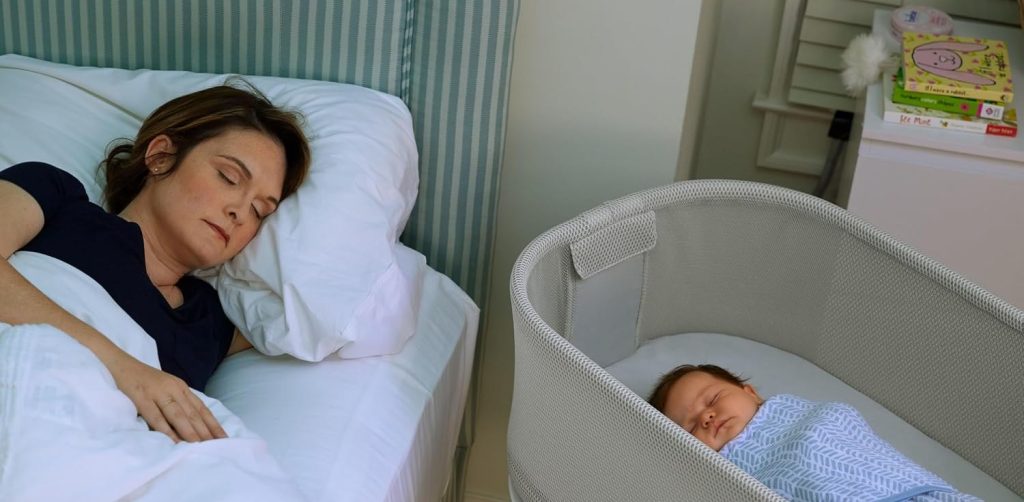
- Every sleep should be a safe sleep: on the back, in an empty crib or bassinet.
How much sleep do babies need?
| Age | Total sleep in 24 hours | Typical naps |
|---|---|---|
| 0–3 months | 14–17 hours | 4–6+, irregular |
| 4–6 months | 12–16 hours | 3–4 |
| 7–9 months | 12–16 hours | 2–3 |
| 10–12 months | 12–16 hours | 2 |
| 12–24 months | 11–14 hours | 1–2 (most move to one nap between 13 and 18 months) |
Ranges are wide because babies are genuinely different. A baby who sleeps at the lower end but wakes happy, feeds well and is growing on track is usually getting what they need.
Newborn sleep (0–3 months): follow, don’t force
Newborns cycle through sleep roughly every 45–60 minutes and need to feed every two to three hours, around the clock. Their internal clock (circadian rhythm) isn’t working yet, so a strict schedule simply isn’t realistic — and trying to stretch feeds to fit one can affect weight gain and milk supply.
What helps at this stage:
- Daylight by day, dim by night. Open curtains and keep normal household noise during daytime naps; keep night feeds dark, quiet and boring.
- Short wake times. Many newborns are ready to sleep again after 45–90 minutes awake, including the feed.
- A mini bedtime routine from around six to eight weeks — feed, change, sleep sack, a song — to start building sleep associations.
A typical newborn day is simply: wake, feed, a little awake time, sleep — repeated eight to twelve times.
Sample schedule: 4–6 months
Around four months, sleep matures and longer night stretches become possible (this is also when the 4-month sleep regression often shows up). Wake windows lengthen to roughly 1.5–2.5 hours.
| Time | What’s happening |
|---|---|
| 7:00 am | Wake & feed |
| 8:45 am | Nap 1 (1–1.5 h) |
| 10:15 am | Feed, play, tummy time |
| 12:15 pm | Nap 2 (1–1.5 h) |
| 1:45 pm | Feed, outdoor time |
| 3:45 pm | Nap 3 (30–45 min catnap) |
| 4:30 pm | Feed, calm play |
| 6:30 pm | Bath, feed, bedtime routine |
| 7:00–7:30 pm | Bedtime (one or more night feeds are still normal) |
Sample schedule: 7–9 months
Most babies drop the late-afternoon catnap and settle into two solid naps, with wake windows of about 2.5–3.5 hours. Solid foods now fit around milk feeds — see our baby feeding schedule for how meals slot in.
| Time | What’s happening |
|---|---|
| 6:45 am | Wake, milk feed |
| 8:00 am | Breakfast (solids) |
| 9:30 am | Nap 1 (1–1.5 h) |
| 11:00 am | Milk feed, play |
| 12:00 pm | Lunch |
| 2:00 pm | Nap 2 (1–1.5 h) |
| 3:30 pm | Milk feed, outing |
| 5:30 pm | Dinner |
| 6:45 pm | Bath, milk, books |
| 7:15 pm | Bedtime |
Sample schedule: 10–12 months
Two naps continue, wake windows stretch to around 3–4 hours, and many babies sleep 10–12 hours at night. Some begin to resist the second nap — try pushing it a little later before assuming they’re ready for one nap, which usually happens after the first birthday.
- Wake: 6:30–7:00 am
- Nap 1: about 3 hours after waking, 1–1.5 hours
- Nap 2: about 3–3.5 hours after nap 1 ends, 1–1.5 hours
- Bedtime: about 3.5–4 hours after nap 2 ends, often 7:00–7:30 pm
The bedtime routine that does the heavy lifting
A predictable routine of 20–30 minutes is one of the best-supported tools for better infant sleep. Keep it short, calm and in the same order each night:
- Bath or a warm wash (doesn’t need to be nightly)
- Pajamas, fresh diaper, sleep sack
- Feed — ideally in a dimly lit room
- Brush gums or teeth once they appear
- One or two books or a song
- Into the crib, on their back, drowsy but awake when you can
Putting your baby down drowsy but awake — some of the time, not necessarily every time — gives them practice falling asleep in the place they’ll wake up later in the night. Our guide on how to get your baby to sleep covers settling techniques in detail.
Common schedule problems (and fixes)
Short naps
Naps of 30–45 minutes (one sleep cycle) are normal before five or six months. If short naps continue later, check that wake windows aren’t too short or too long, that the room is dark, and that your baby isn’t always being fed or rocked fully to sleep.
Early-morning waking
Waking before 6 am is often caused by light, noise, an overly long stretch from the last nap to bedtime, or a bedtime that’s too late. Blackout blinds and white noise at a moderate volume help; so can moving bedtime 15–30 minutes earlier.
Frequent night waking
Night feeds are expected for many months, especially for breastfed babies. Beyond that, frequent waking can come from a regression, teething, illness, or a sleep association your baby can’t recreate alone. Rule out hunger and illness first.
- your baby snores loudly, pauses in breathing, or gasps during sleep;
- they are very difficult to wake, or unusually sleepy and feeding poorly;
- sleep problems are affecting feeding, growth, or your own mental health.
Frequently asked questions
When will my baby sleep through the night?
“Sleeping through” means different things to different families. Many babies can manage a six- to eight-hour stretch somewhere between four and six months, but plenty still wake once or twice to feed until nine months or later — that is normal.
Should I wake my baby from a nap?
In the newborn weeks, wake for feeds if your pediatrician has advised it (often if more than three to four hours pass during the day). Later, capping a very long late-afternoon nap can protect bedtime.
What time should bedtime be?
Between about 6:30 and 8:00 pm works for most babies over four months. Earlier is often better if naps were short.