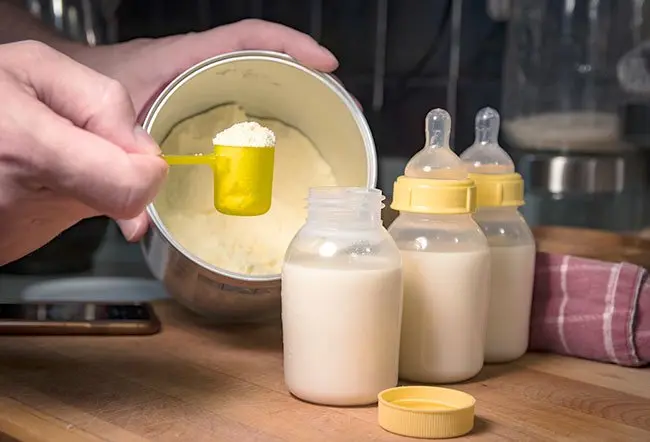
Formula feeding is a safe, nourishing way to feed your baby, whether you use it from day one, alongside breast milk, or after weaning. The essentials are simple but important: choose a standard infant formula unless your pediatrician advises otherwise, mix it exactly as the label says, keep everything clean, and follow your baby’s hunger and fullness cues rather than a fixed number of ounces.
Key takeaways
- Most babies do well on a standard cow’s-milk-based infant formula. Specialty formulas are for specific medical needs.
- Never add extra water or extra powder — incorrect dilution can make babies seriously ill.
- Don’t use homemade formula, toddler milk or cow’s milk as a drink for babies under 12 months.
- Use prepared formula within 2 hours (or within 1 hour once a feed starts), and refrigerate unused bottles for up to 24 hours.
- Newborns take about 1–2 oz per feed at first, rising to roughly 4 oz by the end of the first month.
Types of formula
| Form | Pros | Watch out for |
|---|---|---|
| Powder | Least expensive, light, long shelf life | Must be measured and mixed precisely |
| Liquid concentrate | Quicker to prepare | Must be mixed with an equal amount of water — never served undiluted |
| Ready-to-feed | No mixing, sterile until opened — useful for newborns and travel | Most expensive; use opened containers within the label’s time limit |
Choosing a formula
All infant formulas sold in the US must meet the same FDA nutrient and safety requirements, so a store brand is nutritionally comparable to a name brand. For most babies, a standard iron-fortified cow’s-milk-based formula is the right starting point.
- Partially hydrolyzed / “gentle” or “comfort” formulas may suit some fussy babies, though evidence is mixed.
- Extensively hydrolyzed and amino-acid formulas are used for diagnosed cow’s milk protein allergy — use these on medical advice.
- Soy formula has limited uses (for example, galactosemia or families who avoid all animal products). It is not recommended to prevent allergy, and many babies allergic to cow’s milk also react to soy.
- Lactose-free formula is rarely needed; true lactose intolerance is uncommon in infants.
Switching brands of the same type is generally fine. Talk to your pediatrician before changing type because of symptoms like rash, blood in stool, vomiting or poor weight gain.
How to prepare formula safely
- Wash your hands and clean the preparation area.
- Use clean bottles. Sterilise before first use. For babies under three months, born prematurely or with a weakened immune system, sanitise feeding items at least once a day.
- Use safe water. Tap water that’s safe to drink is fine for most babies in the US; if you’re unsure about your supply, ask your pediatrician or use boiled and cooled water.
- Water first, then powder. Use the scoop that comes with that formula and level it off — don’t pack it.
- Mix well and check the temperature on your inner wrist. Room-temperature or slightly warm is fine; babies don’t need warm milk.
- Never microwave bottles — they heat unevenly and can scald.
How much and how often?
| Age | Amount per feed (approx.) | Feeds in 24 hours |
|---|---|---|
| First days | 1–2 oz (30–60 ml) | 8–12 |
| 2 weeks – 1 month | 2–4 oz (60–120 ml) | 7–8 |
| 2 months | 4–5 oz (120–150 ml) | 6–7 |
| 4 months | 4–6 oz (120–180 ml) | 5–6 |
| 6 months | 6–8 oz (180–240 ml) | 4–5, plus solids |
A rough guide is about 2½ oz per pound of body weight per day, and most babies don’t need more than about 32 oz (960 ml) in 24 hours. Your baby’s appetite will vary — let them stop when they’re full rather than finishing the bottle. Our feeding schedule guide shows how milk and solids fit together later on.
Hunger and fullness cues
- Hungry: rooting, sucking on hands, lip-smacking, getting more alert — crying is a late cue.
- Full: slowing down, turning away, closing lips, relaxed hands, falling asleep.
Feeding technique
Hold your baby semi-upright with head and neck supported, and keep the bottle tilted just enough to fill the nipple. Paced bottle feeding — pausing every few minutes and letting your baby draw milk in — helps prevent overfeeding and gulping air. Burp midway and at the end. Never prop a bottle or put a baby to bed with one. Our bottle feeding guide covers nipples, flow rates and bottle refusal.
Storage rules
- Use prepared formula within 2 hours of mixing, and within 1 hour once your baby starts feeding from it. Throw away leftovers.
- If you prepare bottles ahead, refrigerate them immediately and use within 24 hours.
- Once opened, use powder within the time on the label (often about a month) and keep the lid closed and the scoop dry.
Common concerns
Spit-up and gas
Small spit-ups are normal. Smaller, more frequent feeds, upright time after feeds and paced feeding often help. Forceful or green vomiting, poor weight gain or signs of pain need a medical review.
Constipation
Formula-fed babies often poop less often and with firmer stools than breastfed babies. Hard, pebble-like stools or straining with distress are worth discussing with your pediatrician — don’t change the amount of water in the formula.
Formula shortages
If you can’t find your usual formula, a different brand of the same type is generally fine. Never water down formula to stretch it or make it at home.
- has fewer wet diapers, is very sleepy or hard to wake for feeds;
- vomits forcefully or repeatedly, or has blood in their stool;
- develops hives, swelling or breathing difficulty after feeding (call emergency services for breathing problems);
- isn’t gaining weight as expected.
Formula-feeding helpers

Frequently asked questions
Can I mix breast milk and formula?
Yes, combination feeding is common. Prepare formula with water first as directed, then offer breast milk separately or add it to a correctly prepared bottle — never use breast milk instead of water to mix powder.
Do I need special baby water?
Not usually. Safe tap water is fine for most families. If you use well water or are unsure of your water quality, ask your pediatrician.
When do babies stop formula?
Around 12 months, most babies switch to whole cow’s milk (or a suitable alternative your pediatrician recommends) offered in a cup alongside meals.